Follow palashbiswaskl on Twitter

PalahBiswas On Unique Identity No1.mpg

Unique Identity Number2

Please send the LINK to your Addresslist and send me every update, event, development,documents and FEEDBACK . just mail to palashbiswaskl@gmail.com

Website templates

Zia clarifies his timing of declaration of independence

What Mujib Said

Jyoti Basu is dead

Dr.BR Ambedkar

Memories of Another day

Memories of Another day
While my Parents Pulin babu and Basanti Devi were living

Monday, July 18, 2011

His Majesty's Opponent: Subhas Chandra Bose and India's Struggle against Empire

YouTube - Book Launch - His Majesty's Opponent by Sugata Bose ...

www.youtube.com/watch?v=uwpCQ_DaGIs6 min - 5 Jul 2011 - Uploaded by robinstienberg
On July 5th 2011, ISEAS & Indian High Commission Embassy organized a book launch held at the Singapore Recreation Club.
  • YouTube - His Majesty's Opponent FINAL‏

    www.youtube.com/watch?v=l1yrxyW5sPE2 min - 3 Jun 2011 - Uploaded by penguinindia
    His Majesty's Opponent FINAL. penguinindia 26 videos. Subscribe Alert icon Subscribed. Sign In or Sign Up now! Loading... Alert icon ...
  • Anti-colonial nationalist on a global odyssey

    Ashoke Nag, ET Bureau Jul 15, 2011, 08.12am IST

    Harvard University Professor Sugata Bose tells ET's Ashoke Nag in an exclusive interview that he wanted to reintroduce Subhas Chandra Bose to the younger generation as the military hero who also had well defined views about the social and economic reconstruction of India once the country attained freedom. Excerpts:

    How did the germ of this book initially take root?

    Well, I did not write this book because he happens to be my grand uncle. That is an accident of birth which I have always been taught by my father to discount. There were many friends, particularly in the publishing world, who had been saying for some time that I should drop my inhibitions simply because he is my grand uncle and write such a biography because I'm so knowledgeable about his writings and all the archival historical documentary material associated with him.

    And, it was after my previous major book, A Hundred Horizons, came out, that I decided I would write this biography, because Netaji's life could be narrated in the context of the global history in the first half of the 20th century. I had become very interested in inter-regional, global, connective history that transcends the borders of territorial nation-states.

    And, here I found a person who was an anti-colonial nationalist, but who embarked on a global odyssey. And, therefore a biography of such a person would also advance the cause of historical graphical innovation.

    You had a lot of research material at your disposal being a historian of such stature. What is the research that went into it and when did you start working on the book?

    That is a very hard question to answer. I wrote the book very fast, during a sabbatical from Harvard in the academic year 2009- 2010. But, I had talked to and even formally interviewed men and women who had worked with Netaji Subhas Chandra Bose, as I was growing up, whenever they visited our home in Calcutta, as a young student of history.

    From 1992, I joined my father Sisir Kumar Bose in editing Netaji's collected works. But I focused on this particular project in terms of my research from about 2006 onwards. And, of course, I used archival materials in many countries, including Britain, Germany, Japan and all of Southeast Asia.

    But, one advantage was that my father had tried to collect all of Netaji's letters, essays, other documents associated with him, photographs, his voice recordings, film footage from all over the world here at the Netaji Research Bureau at Kolkata.

    So, this is a wonderful archive and museum where any major project on Netaji and the Indian freedom movement has to begin. So, I systematically worked on this vast material in different parts of the world, but also gathered here from different parts of the world and then decided to write it up during year 2009-10.

    But, despite this vast reservoir of research material, you had to travel a lot to other parts of the world to do interviews and source research material.....

    Yes, I worked in archives in many parts of the world. I was also interested in visiting places that had been associated with Netaji. Sometimes, not in search of archival or documentary materials, but just to get a flavour of the place. Let me give you one example.

    Netaji's favourite hill resort in Europe was a place called Badgastein, near Salzburg in Austria. That is where he spent time with Emily Shenkel (Netaji's Austrian wife). There are no archives there. But, I needed to visit the place. So, I went there.

    If I hadn't visited this place myself, I wouldn't have understood why Subhas Chandra Bose was so enchanted by this place, which I could see reflected in his letters. It was also important for me to be in Singapore. And, not just to talk to people who are still alive and who remember having seen him.

    But, just to see the City Hall, the place where the Indian National Army (INA, the famed regiment Netaji had formed) had gathered and where Netaji had made his famous speeches. This helped me evoke the atmosphere of those times.

    Do you think a comprehensive biography of Netaji was long overdue?

    There was one written by Hugh Toye in 1959. And, Leonard Gordon wrote the last one in 1990. But, since then, a lot of new material has become available. And, therefore, I think the time was overdue for a really good biography of Netaji in the context of global history.

    And, the other point to make is that Netaji has not been forgotten, certainly not in South Asia. But, he is remembered more as a legend and there are various myths circulating around him. But, I think his life and work is more important and fascinating and it should be before the reading public, especially those belonging to the younger generation.

    Indeed, Netaji was a military hero, but he was a warrior who paused between battles. He had a philosophical bent of mind and was a thinker and he actually had some well defined views about the social and economic reconstruction of India once the country attained freedom. He was a leader who believed that India would be free.

    How did you deal with the complexities of Indian politics at that time?

    You know, one of the things I've tried to do, in a chapter titled, 'A Warrior and A Saint', is to interpret the complexities of Indian politics in the 1930s for a general readership. And, also to delve into the differences and similarities between Gandhi and Subhas Chandra Bose at that time.

    In terms of economic thinking, Subhas Chandra was closer to Jawaharlal Nehru. He believed in an Indian variant of socialism and modern industries and harnessing modern science and medicine for the rebuilding of free India.

    Gandhi and Gandhians thought of India of the past and of a golden age of self-supporting village communities and so forth.

    How did you approach the phenomenon of Netaji taking a different path of planning a military attack as there were differences on that front in the freedom struggle?

    Yes. Of course, Netaji participated in the noncooperation and civil disobedience movements in the 1920s and 1930s, led by Mahatma Gandhi. He believed that the best way to proceed was non-violence where the bulk of the population was disarmed.

    So, from 1921 to 1941, he followed Gandhi's leadership. But, he always believed that at the final moment of the Indian freedom struggle, a resort to arms may be necessary to expel British power from India.

    And, he realised that Indian soldiers had been successfully kept insulated by the British for years from the swirling currents of discontent among the Indian masses. That is the reason he went abroad to gain access to Indian soldiers who were being held as prisoners of war by enemies of the British and eventually raised an Indian army in Southeast Asia to come to the aid of unarmed freedom fighters in India.

    So, I have explained the context in which this happened.

    There has always been a mystery surrounding Netaji's end. Have you succeeded in unravelling documentary evidence on this score?

    From all evidence, his end came on August 18, 1945 (at age 48) from grievous injuries he suffered from a fighter-bomber crash. This was a time of great confusion, three days after Japan had surrendered, but hostilities were still continuing. Netaji was trying to move to another battlefield in a Japanese bomber.

    This is based on the testimony of six of the seven survivors of that crash and that of doctors and medical personnel who treated him in the Taipei military hospital. And, an interpretor who had translated for him on four occasions before, who was brought to the hospital.

    So, I have, of course, offered my own conclusion in the book from all this historical data. So, I think the younger generation, who, I know, are reading this book, should refocus their attention on Netaji's life and work and not give much weight to fruitless controversies over his death.

    In some sense, of course, it was a life of tragedy. Because, here was a man who was completed devoted to the cause of India's freedom and he did not see for himself that the country was free. In fact, in his last message on August 15, 1945, he ended by saying that 'India shall be free, and before long'.

    And, that did happen, but he was not there to see that day. On the other hand, he was always ready to sacrifice his life for the country. In that sense, he was successful in his mission. Netaji had said that an individual may die but, through his sacrifices, he becomes heir to a life immortal. And, that's exactly what he became.

    http://articles.economictimes.indiatimes.com/2011-07-15/news/29778014_1_netaji-research-bureau-material-global-odyssey/4

    'His life is more appealing than the legend'

    By: Dhamini Ratnam    

    Harvard University professor, grand nephew of Subhas Chandra Bose and author of the latest biography on Netaji, Sugata Bose tells Sunday Mid day why Bose would have been a disappointed man today

    On July 5, exactly 68 years after Subhas Chandra Bose was handed control of the Indian National Army in Singapore, his grand nephew Sugata Bose visited the city to release a biography of his grand uncle, one of the gigantic figures of the Indian freedom struggle, who is best known for the role he played in rallying Indian soldiers for the Azad Hind Fauj, or the Indian National Army in 1943.


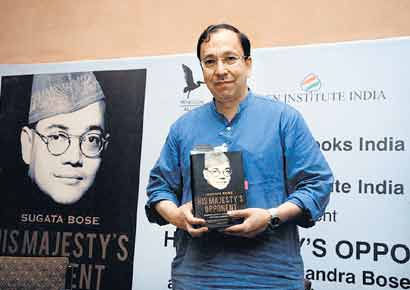
    Pic/ Atul Kamble

    In His Majesty's Opponent, Bose uses previously unpublished letters and photographs, sourced from different corners of the world where Netaji travelled to and wrote from, in a bid to present to the world Subhas Chandra Bose as "a human being of flesh-and-blood and not just a military hero".

    Excerpts from an interview with the author.

    The way we present our history to ourselves, especially of the Independence Movement, is through legend-making and deification. Netaji's house in Cuttack is now a museum. How do you think that takes away from who Netaji really was?
    Deification can lead to a complete distortion of a person's real life. That's why there always needs to be some element of critical assessment and evaluation. I'm not saying one needs to be cynical in one's approach to the lives of great men and women, but one should not dispense with one's critical faculties either.

    Having a museum or an archive is not a bad thing. In many ways, what my father did by setting up the Netaji Research Bureau in Kolkata  in 1957 was to make sure that all possible material -- letters, photographs, documents, recordings, film footage -- was all there so that we were able to preserve and later disseminate what were the best traditions of our freedom movement. It was not done in the spirit of deification, but in the spirit of documentation for future generations.

    Netaji had many detractors -- those who criticised him for his wartime alliances with the Axis Powers (Japan, Germany, Italy). Sometimes I feel, those who went overboard in deifying him might, in some sense, have done a bit more harm than his detractors, since you could answer his detractors with a reasoned argument.

    You don't learn anything from just garlanding his statues, and I hope the younger generation learns from his life.

    Having looked at the past and analysed the period of Indian history where there was a call to a greater cause, what do you think Netaji's reaction would have been to the present state of affairs?
    There was a tremendous amount of idealism in his life. If you look at his passports, under occupation, he always wrote 'public servant'. Looking at today, he would have been rather saddened by the fact that most people want to take something. He would have wanted the young people of India to be giving. He was constantly speaking for the underdogs of society, whoever happened to be marginalised along lines of gender, class or caste.

    These days I hear about fasts and hunger strikes -- Netaji undertook two fasts in his life, and both were in prison. He was dead serious and wouldn't take these kinds of things lightly. I think what he would have liked to see in today's India, is a spirit of service among the people, particularly younger people.

    There are so many versions of Netaji -- of his relationship with Gandhi, his position within the Congress, of the way he passed away. Was this book an attempt to lay to rest rumours and differing accounts of Netaji's work and life?
    One of the things I wanted to do was to present his life in the context of global history, and convey, particularly to a young readership, his multi-faceted personality. We typically have a very one dimensional view of him as a warrior hero, but that was not all there was to him.

    The life is more fascinating than the legend. I wanted to bring out the Subhas Chandra Bose who read philosophy, who wrote about ethical struggles, who wrote about art, culture, music. One category of sources I've used the most are his private letters to members of his family, to friends, particularly from prison and exile.

    His Majesty's Opponent: Subhas Chandra Bose and India's Struggle against Empire by Sugata Bose. Published by Allen Lane. Rs 699

    http://www.mid-day.com/news/2011/jul/170711-Subhas-Chandra-Bose-biography-Sugata-Bose.htm

    India

    Relative chronicles Subhash Chandra Bose's life

    Priyanka GuptaPriyanka Gupta , CNN-IBN
    Updated Jul 17, 2011 at 12:39am IST

    Kolkata: A new book on the life of Subhash Chandra Bose sheds light on the freedom fighter's life and times.

    His Majesty's opponent - Subhash Chandra Bose - the life of Netaji chronicled by his grand nephew Sugato Bose. A childhood replete with tales of Netaji's heroic adventures has helped this Harvard University professor and prominent historian recount India's prominent freedom fighter from close quarters.

    Professor Sugato Bose said, "My father told me that never claim special privelege because of an accident of birth. So don't consider yourself as a relative."

    An objective biography apart, Bose tries to justify Netaji's oft-criticised strategic alliance with the axis powers of Nazi Germany and Mussolini's Italy against the British Empire's imperialist forces.

    "Strategic alliance with axis- I have had to justify it- Netaji's one meeting with Hitler is like Churchil's meet as well. Judge Netaji by the same yardstick as you would for other leader," said Sugato Bose.

    On a different note, the book also looks at Netaji the man and his romantic love for Emile Schenkel in Vienna.

    "His life is a part of adventure- he is not only a romantic national hero but also a romantic in private life," said Sugato Bose.

    114 years after Netaji's birth and 64 years after Independence, the book presents the fight of a hero for a country beset with terror and corruption.

    Sugato Bose said, "His example can be called upon at times of crises and have some degree of idealism when we are beset with corruption."

    Rumours of Netaji being alive have been doing the rounds unfailingly for the past 64 years and the book offers a kind of closure to the numerous conspiracy theories. It also leaves you wondering if we desperately want him to be alive as we see him as our last hope of idealism and courage in such crisis-ridden times.

    http://ibnlive.in.com/news/a-book-on-netaji-subhash-chandra-boses-life/168034-3.html

    Looking back into family history: Sugata Bose
    Published: Friday, Jul 15, 2011, 17:00 IST
    By Shreya Badola | Place: Mumbai | Agency: DNA
    Sugata Bose

    Despite his close relation with legendary freedom fighter Subhas Chandra Bose (Netaji), author and historian Sugata Bose insists that he wrote his latest book His Majesty's Opponent — which explores the public and private life of Netaji — as a historian and not as a family member.

    "I wrote this book as a historian not as a family member, and not as a Bengali for sure. After all, I had never seen Netaji," says Sugata. "Also, I have always been told by my father that his uncle said that his family and country were coterminus. And that I should never get any privilege based on the accident of birth in the same family," he adds.

    Sugata says that he grew up like any other Indian and he always looked up at Netaji as a historical, public figure. And while we may think it was expected of him to write a book on Netaji, Sugata explains that the fact that he belonged to Netaji's family made him rather more hesitant. "If there was any hesitation in my writing this book till now, that has got to do with the fact that I wanted to distance myself from my subject," he says.

    Sugata, who is the Gardiner Professor of Oceanic History and Affairs at Harvard University, was always much fascinated by Netaji since childhood. And he admits that his inclination towards history was in a way propelled by the fact that he belonged to Netaji's family. He took charge of the Netaji Research Bureau in Calcutta after his father's demise.

    Sugata has authored several books on the economic, social and political history of modern South Asia. His past works include Peasant Labour and Colonial Capital (1993), Modern South Asia: History, Culture, Political Economy (1998, 2004, 2011, with Ayesha Jalal) and his much-acclaimed work, A Hundred Horizons: The Indian Ocean in the Age of Global Empire (2006).

    "For anyone else to write this book, that person would have had to spend so much time doing the research, but since I had already done the research I thought why not I write the book myself," jokes the writer. And perhaps that is why it did not take him long to write the book. "The actual writing of His Majesty's Oppnent was done very fast... during a year of sabbatical from Havard." It is also the first book by Sugata, which was written by him while he was in

    Looking back into family history: Sugata Bose
    Published: Friday, Jul 15, 2011, 17:00 IST
    By Shreya Badola | Place: Mumbai | Agency: DNA
    Sugata Bose

    Despite his close relation with legendary freedom fighter Subhas Chandra Bose (Netaji), author and historian Sugata Bose insists that he wrote his latest book His Majesty's Opponent — which explores the public and private life of Netaji — as a historian and not as a family member.

    "I wrote this book as a historian not as a family member, and not as a Bengali for sure. After all, I had never seen Netaji," says Sugata. "Also, I have always been told by my father that his uncle said that his family and country were coterminus. And that I should never get any privilege based on the accident of birth in the same family," he adds.

    Sugata says that he grew up like any other Indian and he always looked up at Netaji as a historical, public figure. And while we may think it was expected of him to write a book on Netaji, Sugata explains that the fact that he belonged to Netaji's family made him rather more hesitant. "If there was any hesitation in my writing this book till now, that has got to do with the fact that I wanted to distance myself from my subject," he says.

    Sugata, who is the Gardiner Professor of Oceanic History and Affairs at Harvard University, was always much fascinated by Netaji since childhood. And he admits that his inclination towards history was in a way propelled by the fact that he belonged to Netaji's family. He took charge of the Netaji Research Bureau in Calcutta after his father's demise.

    Sugata has authored several books on the economic, social and political history of modern South Asia. His past works include Peasant Labour and Colonial Capital (1993), Modern South Asia: History, Culture, Political Economy (1998, 2004, 2011, with Ayesha Jalal) and his much-acclaimed work, A Hundred Horizons: The Indian Ocean in the Age of Global Empire (2006).

    "For anyone else to write this book, that person would have had to spend so much time doing the research, but since I had already done the research I thought why not I write the book myself," jokes the writer. And perhaps that is why it did not take him long to write the book. "The actual writing of His Majesty's Oppnent was done very fast... during a year of sabbatical from Havard." It is also the first book by Sugata, which was written by him while he was in

    Looking back into family history: Sugata Bose
    Published: Friday, Jul 15, 2011, 17:00 IST
    By Shreya Badola | Place: Mumbai | Agency: DNA
    Sugata Bose

    Despite his close relation with legendary freedom fighter Subhas Chandra Bose (Netaji), author and historian Sugata Bose insists that he wrote his latest book His Majesty's Opponent — which explores the public and private life of Netaji — as a historian and not as a family member.

    "I wrote this book as a historian not as a family member, and not as a Bengali for sure. After all, I had never seen Netaji," says Sugata. "Also, I have always been told by my father that his uncle said that his family and country were coterminus. And that I should never get any privilege based on the accident of birth in the same family," he adds.

    Sugata says that he grew up like any other Indian and he always looked up at Netaji as a historical, public figure. And while we may think it was expected of him to write a book on Netaji, Sugata explains that the fact that he belonged to Netaji's family made him rather more hesitant. "If there was any hesitation in my writing this book till now, that has got to do with the fact that I wanted to distance myself from my subject," he says.

    Sugata, who is the Gardiner Professor of Oceanic History and Affairs at Harvard University, was always much fascinated by Netaji since childhood. And he admits that his inclination towards history was in a way propelled by the fact that he belonged to Netaji's family. He took charge of the Netaji Research Bureau in Calcutta after his father's demise.

    Sugata has authored several books on the economic, social and political history of modern South Asia. His past works include Peasant Labour and Colonial Capital (1993), Modern South Asia: History, Culture, Political Economy (1998, 2004, 2011, with Ayesha Jalal) and his much-acclaimed work, A Hundred Horizons: The Indian Ocean in the Age of Global Empire (2006).

    "For anyone else to write this book, that person would have had to spend so much time doing the research, but since I had already done the research I thought why not I write the book myself," jokes the writer. And perhaps that is why it did not take him long to write the book. "The actual writing of His Majesty's Oppnent was done very fast... during a year of sabbatical from Havard." It is also the first book by Sugata, which was written by him while he was in

    By Sugata Bose
     
     
    View Larger Image of His Majesty's Opponent: Subhas Chandra Bose and India's Struggle against Empire By Sugata Bose
    Print this Page of His Majesty's Opponent: Subhas Chandra Bose and India's Struggle against Empire By Sugata Bose
    Email to a Friend His Majesty's Opponent: Subhas Chandra Bose and India's Struggle against Empire By Sugata Bose
     
    Selling Price : Rs 699.00
    Buy His Majesty's Opponent: Subhas Chandra Bose and India's Struggle against Empire By Sugata Bose


    Netaji Subhas Chandra Bose dedicated his life to the struggle to liberate his people from British rule. In pursuit of that goal he raised and led the Indian National Army against Allied Forces during World War II. This was a man whose patriotism was, as Mahatma Gandhi declared, second to none; nonetheless aspects of his life and death continue to be controversial both in India and abroad even today.

    In this definitive biography, Professor Sugata Bose analyzes Netaji's life and legacy, tracing the intellectual impact of his years in Calcutta and Cambridge, the ideas and relationships that influenced him during his time in exile, and his ascent to the peak of nationalist politics.  Using previously unpublished family archives, this account not only documents Subhas Bose's thoughts during his imprisonment and travels, but also illuminates the profundity of his struggle to unite the diversities of India—religious, economic, linguistic—into a single independent nation.

    His Majesty's Opponent is a magisterial study of a life larger than its legend. Both intimate and global in significance, it is the portrait of a man, whose public and private life encapsulated the contradictions of world history in the first half of the twentieth century.

    Book Reviews
    User Reviews
    Post Your Review
    Published by :
    Published :  15-Jun-2011
    Imprint : Allen Lane
    ISBN : 9780670084210
    Edition :
    Format : Royal
    Extent : 408pp with 40pp illustrations
    Classification : Biography
    Rights : Indian Subcontinent and Maldives only
     

    Looking back into family history: Sugata Bose
    Published: Friday, Jul 15, 2011, 17:00 IST
    By Shreya Badola | Place: Mumbai | Agency: DNA
    Sugata Bose

    Despite his close relation with legendary freedom fighter Subhas Chandra Bose (Netaji), author and historian Sugata Bose insists that he wrote his latest book His Majesty's Opponent — which explores the public and private life of Netaji — as a historian and not as a family member.

    "I wrote this book as a historian not as a family member, and not as a Bengali for sure. After all, I had never seen Netaji," says Sugata. "Also, I have always been told by my father that his uncle said that his family and country were coterminus. And that I should never get any privilege based on the accident of birth in the same family," he adds.

    Sugata says that he grew up like any other Indian and he always looked up at Netaji as a historical, public figure. And while we may think it was expected of him to write a book on Netaji, Sugata explains that the fact that he belonged to Netaji's family made him rather more hesitant. "If there was any hesitation in my writing this book till now, that has got to do with the fact that I wanted to distance myself from my subject," he says.

    Sugata, who is the Gardiner Professor of Oceanic History and Affairs at Harvard University, was always much fascinated by Netaji since childhood. And he admits that his inclination towards history was in a way propelled by the fact that he belonged to Netaji's family. He took charge of the Netaji Research Bureau in Calcutta after his father's demise.

    Sugata has authored several books on the economic, social and political history of modern South Asia. His past works include Peasant Labour and Colonial Capital (1993), Modern South Asia: History, Culture, Political Economy (1998, 2004, 2011, with Ayesha Jalal) and his much-acclaimed work, A Hundred Horizons: The Indian Ocean in the Age of Global Empire (2006).

    "For anyone else to write this book, that person would have had to spend so much time doing the research, but since I had already done the research I thought why not I write the book myself," jokes the writer. And perhaps that is why it did not take him long to write the book. "The actual writing of His Majesty's Oppnent was done very fast... during a year of sabbatical from Havard." It is also the first book by Sugata, which was written by him while he was in

    Looking back into family history: Sugata Bose
    Published: Friday, Jul 15, 2011, 17:00 IST
    By Shreya Badola | Place: Mumbai | Agency: DNA

    Despite his close relation with legendary freedom fighter Subhas Chandra Bose (Netaji), author and historian Sugata Bose insists that he wrote his latest book His Majesty's Opponent — which explores the public and private life of Netaji — as a historian and not as a family member.

    "I wrote this book as a historian not as a family member, and not as a Bengali for sure. After all, I had never seen Netaji," says Sugata. "Also, I have always been told by my father that his uncle said that his family and country were coterminus. And that I should never get any privilege based on the accident of birth in the same family," he adds.

    Sugata says that he grew up like any other Indian and he always looked up at Netaji as a historical, public figure. And while we may think it was expected of him to write a book on Netaji, Sugata explains that the fact that he belonged to Netaji's family made him rather more hesitant. "If there was any hesitation in my writing this book till now, that has got to do with the fact that I wanted to distance myself from my subject," he says.

    Sugata, who is the Gardiner Professor of Oceanic History and Affairs at Harvard University, was always much fascinated by Netaji since childhood. And he admits that his inclination towards history was in a way propelled by the fact that he belonged to Netaji's family. He took charge of the Netaji Research Bureau in Calcutta after his father's demise.

    Sugata has authored several books on the economic, social and political history of modern South Asia. His past works include Peasant Labour and Colonial Capital (1993), Modern South Asia: History, Culture, Political Economy (1998, 2004, 2011, with Ayesha Jalal) and his much-acclaimed work, A Hundred Horizons: The Indian Ocean in the Age of Global Empire (2006).

    "For anyone else to write this book, that person would have had to spend so much time doing the research, but since I had already done the research I thought why not I write the book myself," jokes the writer. And perhaps that is why it did not take him long to write the book. "The actual writing of His Majesty's Oppnent was done very fast... during a year of sabbatical from Havard." It is also the first book by Sugata, which was written by him while he was in

    http://www.dnaindia.com/entertainment/report_looking-back-into-family-history-sugata-bose_1566034

  • July 11, 2011, 10:39 AM IST
  • Book Aims to Repair Freedom Fighter's Image

    A new biography of Indian nationalist hero Subhas Chandra Bose could help resuscitate the leader's troubled reputation outside of India.

    Courtesy Harvard University Press
    A new biography of Subhas Chandra Bose could help resuscitate the leader's troubled reputation outside India.

    Mr. Bose sided with Imperial Japan and the Nazis during World War Two in a move of realpolitik aimed at securing backing for his Indian National Army and its war for an independent India.

    Long a member of the pantheon of Indian nationalist heroes, Mr. Bose is held in mild contempt in the West for his dalliance with totalitarian powers. In Japan, he is still hugely admired, and his ashes are believed to be housed in Tokyo's Renjoki temple.

    Harvard professor Sugata Bose, who is the grandson of the nationalist leader's brother, sets out to correct this one-sided view.

    The book, "His Majesty's Opponent," aims to be the definitive biography of a man who, as the author writes, devoted "his life to ensuring the sun did finally set on the British Empire."

    Mr. Bose's life is an action-packed thriller tailor-made for biographical treatment. The author has purposely aimed the book at a global audience who might know Indian independence icons like Jawaharlal Nehru, the nation's first prime minister or Mahatma Gandhi but not be acquainted with a man whom Indians know as "Netaji," or Respected Leader.

    Mr. Bose, the Harvard professor, wrote the book at Netaji's old family house on Elgin Street in Kolkata.

    The home is now a museum to Mr. Bose, which charts his life. Parked outside is the car in which he escaped British house arrest in 1941, the beginning of an odyssey which would take him all over the world.

    Mr. Bose was born at the close of the 19th Century in Orissa but grew up in Kolkata. Twice elected president of the Indian National Congress in 1938 and 1939, he later clashed with Gandhi because, unlike the Mahatma, he backed violent efforts to oust the British from India.

    After fleeing house arrest he found his way to Moscow and then Berlin, where he met Hitler and married a Austrian woman.

    He travelled by German and Japanese submarines to Singapore, where on Oct. 21, 1943, he proclaimed the formation of the Provisional Government of Azad Hind ("Free India").

    Ultimately, the army he raised — made up largely of Indian soldiers in the British army who had been captured by the Japanese — was unsuccessful. They were beaten in Manipur by British and American forces, and had to retreat.

    Mr. Bose died in a plane crash in Taiwan, never living to see an independent India (There are some who dispute this and his death is shrouded in mystery.)

    But his legacy was long lasting. His actions helped to spark naval rebellions against the British in Mumbai and Karachi in the aftermath of the war. The threat of armed rebellion surely pushed the British to draw the curtain on their Indian empire more quickly than they otherwise would have.

    Mr. Bose also was the first to call Gandhi, with whom he had many disagreements, the "Father of the Nation." And he coined the phrase "Jai Hind," ("Long Live India") now so popular in everyday Indian speech.

    You can follow Mr. Wright on Twitter @TomWrightAsia.

    http://blogs.wsj.com/indiarealtime/2011/07/11/new-book-aims-to-repair-freedom-fighters-image/

    A life & legacy revealed
    Sen unveils 'exciting' book on Netaji
    - IT IS DYNAMIC AND MAKES YOU REFLECT: AMARTYA

    A Nobel laureate from Bengal, a noted historian and the grandnephew of one of Bengal's greatest heroes, and Bengal's modern agent of change — the Town Hall stage on Friday evening was a pride-of-Bengal freeze frame.

    "It's a very exciting person's life history. There's enormous new material for even those who know a good deal about Netaji and it reads like a really exciting piece of history that is dynamic and makes you reflect," was how Amartya Sen summed up His Majesty's Opponent: Subhas Chandra Bose and India's Struggle Against Empire at the Town Hall.

    That makes Sugata Bose's book on his granduncle, published by Penguin India, a must read.

    Something that Mamata Banerjee must have quickly realised, seated between Sen and Bose on the dais. For, she wasted no time in flipping through the first copy of His Majesty's Opponent unveiled by the economist-philosopher and handed over to her with a smile.

    Unveiling over, the grandson of Acharya Kshiti Mohan Sen and the grandnephew of Subhas Chandra Bose settled down for a discussion on the life and legacy of Netaji.

    "This is a book of considerable depth and gravity. Subhas Chandra Bose was an inspirational figure who also had to court many controversies through various stages of his life, in his pursuit of India's independence or in establishing international alliances that were questioned at that time. The book had to address various complexities and I couldn't think of anyone else other than Sugata Bose who could have done justice to it," said Sen in his introduction before going on to prod the Harvard history professor on some interesting insights into the book's celebrated subject.

    After a collage of black-and-white video footage from Netaji's INA days, his address to his "countrymen" and his travels around the world, was screened, the author clarified: "Those were images of Subhas Chandra Bose as a warrior statesman but there were other facets to his personality."

    The gathering got glimpses of some of those facets as the author read out passages from his 325-pager. The discussion on Netaji between Sen and Bose then veered towards the other Bengali icon: Rabindranath Tagore. When Santiniketan's most famous son today — named Amartya by Tagore — raised questions about the tensions and concerns between Tagore and Netaji, Bose clarified: "Netaji understood that Tagore was a patriot who loved his land and did not want India to imitate the nationalism of the West."

    http://www.telegraphindia.com/1110709/jsp/calcutta/story_14215624.jsp

    The last action hero

    A Harvard historian produces the definitive biography of India's maverick military hero

    Soutik Biswas

    What has been lost in the process, as Sugata Bose writes in this magisterial biography of the man, was a "genuine understanding of who he was as a human being and of his place in history". On both accounts, the Harvard historian does a splendid job.

    Note: Bose calls Netaji's association with Hitler a 'pact with a devil'. Keystone/Getty Images

    Note: Bose calls Netaji's association with Hitler a 'pact with a devil'. Keystone/Getty Images

    Bose etches a vivid portrait of Netaji as a protean nationalist of fierce integrity and conviction. At home, he espoused a brand of muscular and secular nationalism, went to British prisons 11 times and was even derided by his opponents as a Bolshevik propagandist. Abroad, the radical leader effortlessly morphed into a global statesman of sorts, trying to forge friendship between Indian and European countries to counter anti-Indian British propaganda. He later raised an army of Indian prisoners of war in exile and allied with the Axis powers to take on the British. He also excelled as a mass politician, and was elected twice to the presidency of the Indian National Congress.

    Netaji was a rousing orator and read voraciously, from philosophy to history and anthropology; he became a specialist of sorts of Irish history and literature. He was also a rare modernist, who believed in a strong, industrialized India free from caste and communalism. Netaji was also exceedingly brave and took enormous risks—hoodwinking the police to escape from India in the middle of the night, embarking on a rough and dangerous submarine voyage from Europe to Asia and boarding a dodgy Japanese bomber to try and reach a new battlefield. He turned into what the writer describes as an uncompromising, though not uncritical, anti-imperialist, decrying both the racism of Nazi Germany and the brute militarism of Japan, but allying with them to free India from British rule.

    At the risk of sounding banal, it is almost tempting to describe him as a flawed Renaissance man.

    The biographer—a grandson of Netaji's brother, Sarat—displays considerable acuity in examining the icon's complex love-hate relationship with Gandhi. It was a fascinating association between a wily saint and a robust warrior, a rebellious son and a stodgy patriarch. Netaji sometimes found a "deplorable lack of clarity" in Gandhi's political strategy, regretting that the saint's struggle was neither militant nor diplomatic enough. In the Congress, where he was elected twice and eventually "outwitted and outmaneuvered" by Gandhi, he fell out with his mentor over Congress participation in coalition governments in Muslim-majority provinces.

    But did Netaji's single-minded obsession with Indian independence end up tarnishing his legacy? Bose calls Netaji's association with Hitler a "pact with a devil", and a "terrible price for freedom". His silence on the ghastly atrocities of Nazis and fascists remains inexplicable. "By going to Germany because it happened to be at war with Britain, he ensured that his reputation would long be tarred by the opprobrium that was due to the Nazis," writes Bose.

    But Netaji was also a prescient man. He believed most Indians would never find communism appealing because of its "lack of sympathy with nationalism ... and (its) antireligious and atheistic elements". He understood Indians well—"India is a strange land," he wrote to his Austrian wife, Emile, in 1939, "where people are loved not because they have power, but because they give up power".

    His Majesty's Opponent: Allen Lane/Penguin, 388 pages, Rs 699.

    His Majesty's Opponent: Allen Lane/Penguin, 388 pages, Rs. 699.

    So was Netaji eventually a tragic hero, who lost his way and died in exile after a doomed military effort to drive the British out of India? Bose insists that the leader's tireless wartime activities—despite the military debacle suffered by the Indian National Army (INA)—hastened India's independence and undermined further colonial conquests. Netaji's admirers, the author writes, believe that if he had been alive India would not have been partitioned along religious lines. But then you have to remember that his much lauded multi-faith army was raised in foreign lands. It was possibly easier to do that, far away from the growing religious tensions at home which eventually led to the dismembering of India.

    Bose writes that Netaji would have been generous towards minorities and worked resolutely towards an equal power-sharing arrangement in independent India. But one could reasonably argue that he could have been outwitted again by the right-wing, hardline sections within the Congress. Did he put too much faith in the cohesiveness of Congress while trying to steer it to a more radical, militant position (the leftists wanted to break away, and there were socialist factions that were unwilling to shed their identities)? Was he naive to believe that a strongly cultural multi-faith nationalism would be good enough to make all communities live peacefully in an intensely fractured society?

    On the other hand, his critics believe he could have easily turned into a dictator, citing his alliances with totalitarian regimes opposed to Britain. Netaji, writes Bose, did speak on three occasions supporting a period of authoritarian rule after independence to speed up socio-economic reform. Bose doubts whether the leader would have turned authoritarian—the "streak of self-abnegation", he writes "was stronger in his character than that of self-assertion".

    Today Netaji has been appropriated by all, from the Hindu right wing for his military heroism and a misreading of his robust nationalism, to muddled Communists who did a volte face and now regard him as a patriot. Idealism may be infra dig today, but India's stormiest petrel remains an enduring hero, and a reminder of the times when leaders dared to dream and walked the talk.

    Soutik Biswas is the India editor of BBC News online.

    Write to lounge@livemint.com

    His Majesty's Opponent

    Subhas Chandra Bose and India's Struggle against Empire

    Sugata Bose

    The man whom Indian nationalists perceived as the "George Washington of India" and who was President of the Indian National Congress in 1938–1939 is a legendary figure. Called Netaji ("leader") by his countrymen, Subhas Chandra Bose struggled all his life to liberate his people from British rule and, in pursuit of that goal, raised and led the Indian National Army against Allied Forces during World War II. His patriotism, as Gandhi asserted, was second to none, but his actions aroused controversy in India and condemnation in the West.

    Now, in a definitive biography of the revered Indian nationalist, Sugata Bose deftly explores a charismatic personality whose public and private life encapsulated the contradictions of world history in the first half of the twentieth century. He brilliantly evokes Netaji's formation in the intellectual milieu of Calcutta and Cambridge, probes his thoughts and relations during years of exile, and analyzes his ascent to the peak of nationalist politics. Amidst riveting accounts of imprisonment and travels, we glimpse the profundity of his struggle: to unite Hindu and Muslim, men and women, and diverse linguistic groups within a single independent Indian nation. Finally, an authoritative account of his untimely death in a plane crash will put to rest rumors about the fate of this "deathless hero."

    This epic of a life larger than its legend is both intimate, based on family archives, and global in significance. His Majesty's Opponent establishes Bose among the giants of Indian and world history.

    http://www.hup.harvard.edu/catalog.php?isbn=9780674047549


    His Majesty's Opponent: Subhas Chandra and India's Struggle Against Empire

    (Harvard University Press, April 2011)

    By Sugata Bose


    Gardiner Professor of Oceanic History and Affairs Sugata Bose parses the life of Indian revolutionary Subhas Chandra Bose, who struggled to liberate his people from British rule and led the Indian National Army against Allied Forces during World War II

    If he had reached Delhi...

    Shobhan Saxena, TNN Jun 19, 2011, 06.57am IST

      His Majesty's Opponent

      By Sugata Bose

      Allen Lane

      Rs 699, 385 pages

      Imagine if the troops of Azad Hind Fauj had marched into Delhi after running over the Anglo-American forces at Imphal and Kohima in 1945. Imagine if Subhas Chandra Bose, dressed in khaki, wearing round-rimmed glasses and a baton in hand, had reached Delhi as the head of the "Provisional Government of India " to unfurl the tricolour at Red Fort. Imagine if Netaji had become the first Prime Minister of India.

      There were too many "ifs" in Bose's life. Probably that's why he still remains an enigma 66 years after his death in a plane crash. Or why India is still craving for a real leader. In the past six decades, numerous people have "seen" him: as Gumnami Baba on the ghats of Ayodhya; as an "unidentified man" who made a brief appearance at Mahatma Gandhi's funeral; and as a prisoner of war in a Russian gulag. Historians are yet to give a clear verdict on his politics. For the Indian right, Bose is just a nationalist military hero. The left hasn't made peace with him yet. And for the liberals, Bose is an untouchable for his dangerous liaisons with the Axis powers.

      So, what was Bose like actually? In this brilliant biography of Netaji, Sugata Bose, professor of history at Harvard and grandnephew of the INA leader, puts all speculations to rest as he tracks the leader's life from his birth in Cuttack to death in Taiwan. The book, packed with interesting anecdotes about his struggles in India, love life in exile, proves beyond doubt that Bose was not an adventurer who jumped from one ideology to another in pursuit of personal glory. And it also dismisses all conspiracy theories about his "mysterious disappearance". But that's not the central idea of the book. It's a remarkable book because it shows Bose as a politician who had a plan — both for India's freedom as well as for the post-Independence scenario. And that's what led to his conflict with Gandhi and Congress ' rightwing represented by the likes of Vallabhbhai Patel and also with Nehru, who he considered his "elder brother". Bose collided with Gandhi because he thought the "premier nationalist party had no definite policy" and it "should depend, for its strength, influence and power on such movements as the labour movement, youth movement, peasant movement, women's movement, student's movement." For people like Patel, this was unacceptable.

      http://articles.timesofindia.indiatimes.com/2011-06-19/book-mark/29676752_1_netaji-gumnami-baba-movement

      Sugata Bose's book on Netaji reads in parts like a thriller
      Last updated on: May 31, 2011 18:17 IST
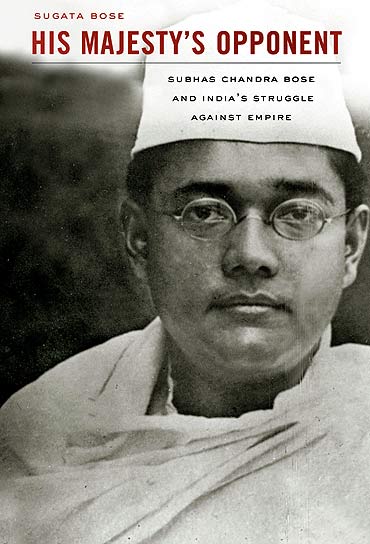
      The book cover
           Next

      Arthur J Pais

      Sugata Bose, author of freedom-fighter Subhas Chandra Bose's biography His Majesty's Opponent, talks to Arthur J Pais about his grand uncle, one of the freedom movement's most intriguing figures. The first of a four-part interview.

      Tomorrow: Emilie Shenkl's letters to Subhas Chandra Bose

      A few pages into His Majesty's Opponent, and you may forget that this book is written is by a renowned Harvard University academic Sugata Bose. For here is a biography of one of the most intriguing and powerful men in 20th century India, Subhas Chandra Bose, written with energy and without sacrificing the historical details.

      Netaji was an uncle of Sugata Bose's father, Sisir Kumar Bose, a distinguished pediatrician and a freedom-fighter. The Harvard historian does not hesitate to execute his duty as a historian.

      For instance, he thoroughly examines Netaji's alliance with the military rulers of Japan and asks the question whether Netaji had embraced rightwing military ideology. He revisits the records that show that Netaji did indeed die in an accidental plane-crash.

      And in the following interview, Professor Bose thinks over why many people refused to believe in the air-crash account and why some perpetuated the myth of a 'deathless hero' many decades after the plane-crash.

      In parts the book, published by Harvard University Press, reads like a thriller, especially when dealing with Netaji's daring escapes from British clutches. There is a spirited account of a secret submarine escape, and riveting material on Netaji's complex political strategies.

      But above everything else, the book offers an intimate portrait of Netaji not only as a revolutionary leader but also a loving husband, a man of letters, and an untiring believer in communal amity.

      It is also a great account of a love story and the story of an Austrian wife who never remarried and brought up her daughter -- Netaji's only child -- single-handedly, despite having to endure many hardships.

      The book also reveals how the Bose family reacted when they came to know of Bose's secret marriage.

      Several academics including the Nobel laureate Amartya Sen have praised the book.

      'Larger than life, more profoundly intriguing than the myths that surround him, Subhas Chandra Bose was India's greatest 'lost' leader,' writes Homi K Bhabha, Harvard professor, in a blurb. 'In a remarkable narrative that pairs political passion with historical precision, Sugata Bose has beautifully explored the character and charisma of the man, while providing an elegant and incisive account of one of the most important phases of the struggle for Indian independence.'

      Sen muses: 'Subhas Chandra Bose was perhaps the most enigmatic of the great Indian leaders fighting for independence in the twentieth century. This wonderful book makes a major contribution to the understanding of the political, social and moral commitments of Netaji, the great leader, as he was called by his contemporaries.'

      And New York University professor Arjun Appadurai applauds the biography, calling it 'remarkable.' It 'places Subhas Chandra Bose fully in the context of Indian and world history. It should be read by everyone interested in the end of the British Empire.'

      This is the kind of book that you read in about two days and wonder, was it really 448 pages long?

      The following interview was conducted mostly in the Harvard University office of Professor Bose, with a few follow-up questions answered through e-mail from Harvard and the city of London where Bose was giving a lecture.

      Click NEXT to read further...


      Image: The book cover
      http://www.rediff.com/news/slide-show/slide-show-1-an-interview-with-netajis-grand-nephew/20110531.htm

      His Majesty's Opponent--Book on Netaji released by Amartya Sen

      Kolkata, Jul 8 : A definitive biography of one of India's greatest leaders Subhas Chandra Bose entitled- 'His Majesty's opponent: Subhas Chandra Bose and India's Struggle Against Empire' was released here today by noble laureate Amartya Sen at a glittering function in the presence of Chief Minister Mamata Banerjee and the author Sugata Bose.

      Published by Penguin Books India the book on Netaji was an attempt to showcase the contribution of Netaji to the understanding of his commiment of political, social and moral affairs.

      After releasing the book, Prof Sen said Netaji dedicated his life to the struggle to liberate his people from the British Raj. This was a man whose patriotism, as Mahatma Gandhi said, was second to none.

      Prof Sen congratulating Dr Bose, the Gardiner Prof of History at Harvard University and Netaji's grand nephew, said in this definitive biography Prof Bose had analysed Netaji's life and legacy besides tracing the intellectual impact of his political life, his ideas and his relationship that influenced him during his time in exile.

      Prof Amartya Sen said the account not only documented Netaji's thoughts during his imprisonment and travels but also tried to project his uncompromising struggle to unite into a single independent nation.

      Though the Chief Minister was present on the dias she did not utter a single word and left the stage to both the eminent speakers.

      Later, the author read out a number of chapters from his book illustrating Netaji's life in Mandille prison in Burma and his relationship with Jawaharlal Nehru, Mahatma Gandhi and Rabindranath Tagore in diefferent fora.

      In this connection Prof Amartya Sen raised a few questions which was answered by Mr Bose aptly.

      --UNI


      No comments: